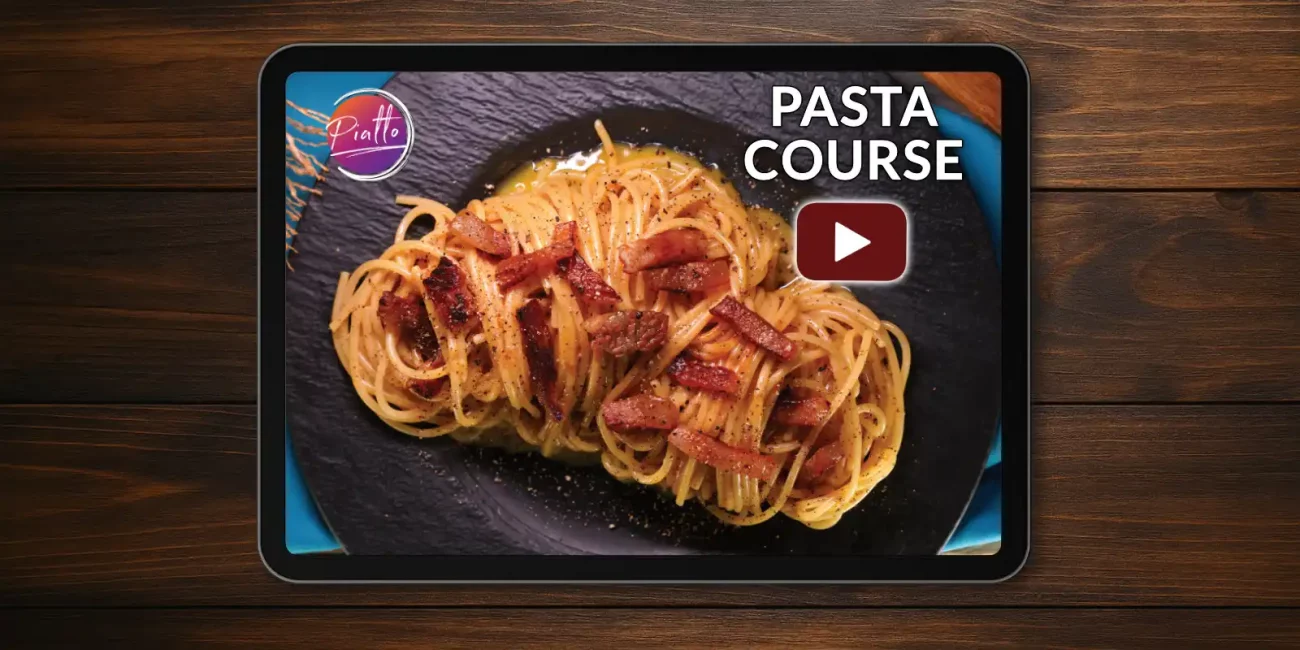
Welcome to your free Carbonara Pasta Course! This iconic Roman dish is one of the four pillars of Roman Pasta —along with Gricia, Cacio e Pepe and Amatriciana. In this lesson, we’ll walk you through a traditional method, show you common mistakes to avoid, and explain how to really make one of the most misunderstood Italian dishes. You won’t find butter, heavy cream or bacon in this authentic recipe!
This course is part of our series of Free Online Italian Cooking Classes for Pasta, where we teach you to cook pasta like Italians do—from dough to dishes.
Video Class Overview
This lesson is filmed in stunning 4K for visual clarity, with subtitles available in English, French, Spanish, German, and other languages.
Each class is structured to walk you through the techniques used by Italian cooks—so you can see what matters (and what doesn’t) when making pasta the traditional way.
Ingredients and How to Make Carbonara Pasta
The full ingredient list and step-by-step instructions are below. We’ve formatted the recipe for easy saving or printing. Be sure to watch the video first—it covers essential technique tips!
We use the most traditional measurements and techniques, so you can recreate this recipe exactly as it would be made in Italy—no shortcuts, no substitutions unless noted.
Equipment and Tools
You don’t need a professional kitchen to make great pasta—but the right tools can make it easier. For this recipe, we recommend:
- Mortar and pestle – for freshly grinding the black pepper.
- Cheese grating tool – for finely grating the Pecorino cheese. We recommend using the fine grater setting on a food processor or Vitamix. For sauces like Cacio e Pepe or Carbonara, we also suggest passing the finely grated Pecorino through a fine sieve to achieve a powdery consistency.
Video Class Overview
Is This Carbonara Pasta Recipe Traditional?
Yes—this is one way that Romans in Italy make Carbonara pasta.
Variations? Sometimes even Romans will use pancetta instead of guanciale (but never bacon). A mix of Parmigiano and Pecorino cheeses can be found in some preparations, though most Romans and Italian purists will tell you that only Pecorino Romano cheese should go in the Carbonara.
Unlike some recipes (such as Amatriciana), Carbonara Pasta has not been codified by any official Italian authority such as a regional Italian ‘Chamber of Commerce’ or similar. Nonetheless, we’ve taken great pains to ensure that the Carbonara Pasta recipe we are sharing with you does align with what is considered traditional for this dish in Italy today. Like many Italian recipes, there are variations within the tradition, but within an accepted list of ingredients.
Pro Tips for Making Carbonara Pasta
Guanciale is More Traditional
Guanciale (cured pork cheek) is more traditional than pancetta (cured pork belly) for this dish. They do have different flavors and textures so use guanciale whenever possible. Never use bacon.
Use Less Water to Cook the Pasta
To boost the starch content of the water you’ll use in the sauce, cook your pasta in half the usual amount of water. Less water means a higher starch concentration, which is essential for creating a stable emulsion with the Pecorino cheese.
Then, finish cooking the pasta in a skillet with the deglazed guanciale drippings, toasted black pepper and a few ladles of the starchy pasta water. This not only intensifies flavor, but also sets up the perfect conditions for mantecatura—the creamy final mix.
Use high-quality, bronze-die cut pasta
This dish relies on the sauce clinging to the pasta and generating enough starch in the pasta water—so the pasta surface matters. Bronze-die cut pasta has a rougher texture that holds onto the sauce better than smooth, industrially extruded pasta. It’s a small detail that makes a big difference in the final result.
Spaghetti is the pasta of choice here.
See our full article on Best Pasta Brands in Italy to learn more.
Finely grate the Pecorino cheese into a powder
Use semi-aged Pecorino and grate it as finely as possible to ensure a smooth, lump-free sauce. You can start with a fine grater or food processor, but for best results, pass the grated cheese through a fine sieve to get a powder-like consistency.
Mantecatura off the heat
Combine the pre-cooked Carbonara sauce and pasta off the heat, stirring vigorously (the mantecatura) to coat each strand. The residual heat and starch will help form that glossy, creamy sauce Romans love.
If you’re using a pan that retains heat well (like stainless steel or carbon steel), let it sit off the heat for about 30 seconds before adding the Carbonara sauce.
Use Pasteurized Eggs
The residual heat from the pasta is NOT enough to render raw eggs safe from foodborne illness. We don’t advise combining the pasta with the egg sauce over heat because eggs approaching the temperature required for food safety are sensitive to coagulation, which will result in a scrambled egg Carbonara!
Please follow the cooking instructions carefully to precook the egg sauce, but better yet use pasteurized egg yolks which are commercially available.
Salt the Pasta Water Less Than Normal
You’ve probably heard (correctly) that pasta should be cooked in salted boiling water. Normally the phrase ‘salty as the sea’ is associated with pasta cooking water. However, when making Roman Pasta dishes with lots of Pecorino cheese, you’ll want to add less salt to the pasta water.
Why? First off, you’ll notice we are cooking the pasta in less water than normal to concentrate the starch for making the sauce more creamy. We are also only partially cooking the pasta in the pot with the salted water and finishing the pasta in the skillet with our guanciale drippings and pepper. We add ladles of the starchy pasta water to that skillet to finish cooking the pasta. For this reason —and because Carbonara includes many salt ingredients like Pecorino and guanciale— we don’t want to over salt the pasta water. Better to add salt to taste at the end if the final pasta needs it.
Common Mistakes to Avoid
Using Bacon, Not Guanciale (or Pancetta)
Bacon (like American bacon) is a product that can be made from various meat cuts and prepared different ways (for instance smoked). Guanciale (cured pork cheek) and pancetta (cured pork belly) are the products used in traditional Italian cooking (not bacon). In most Roman pasta recipes, guanciale is most traditional though occasionally pancetta may be used even by professionals.
Mistaking ‘Original’ Carbonara Recipes for the Traditional One
The origins of Carbonara Pasta are more contested than many Italian recipes. One common origin story repeated even in Italy today is that of the WWII Carbonara with Cream and Bacon. But make no mistake: this is NOT the Carbonara recipe considered authentic or traditional in Italy today. And that means…
No Cream, Bacon, Butter, Onion…
These ingredients have no place in a pasta dish called “Carbonara” and so are not included in this Carbonara Pasta Course.
The Carbonara sauce is an egg and pecorino cheese sauce. Ingredients like cream and butter or often added abroad to simplify the storage of an emulsified sauce—or simply because the Carbonara has been misunderstood.
Adding a Raw Egg On Top…
The Carbonara sauce is itself an egg sauce. We’ve seen some crazy Carbonara Pasta preparations in restaurants outside of Italy, even in restaurants we normally consider to be more faithful to traditional Italian cooking. One such preparation was a ‘Carbonara’ prepared like a Gricia that simply had a raw (hopefully pasteurized egg) served on top of the pasta. No, no and no!
Clumpy, gooey cheese sauce
Despite its simplicity, Carbonara Pasta Sauce is easy to mess up. Common mistakes include:
- Using cheese that isn’t finely grated
- Using fully aged Pecorino that doesn’t melt easily
- Leaving too much liquid in the skillet when mantecatura begins—only a couple of spoonfuls should remain
- Adding the Carbonara sauce to a pan that’s too hot or still on the heat
Learn more about terms like mantecatura in our guide: Essential Italian Culinary Terms and Techniques