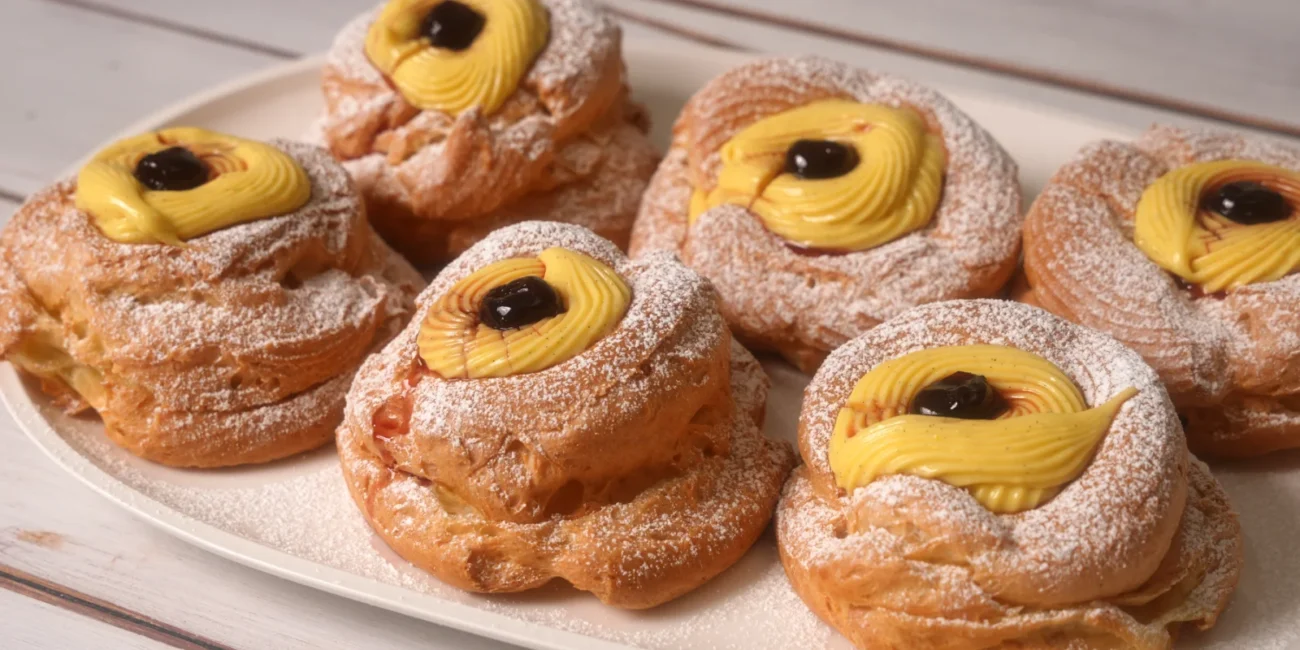

I’ll be honest with you: I tested a lot of recipes before I landed on this one. Zeppole di San Giuseppe are one of those pastries that look straightforward on paper — choux pastry, pastry cream, a cherry on top — and then humbles you in the kitchen. Getting them right took me more attempts than I’d like to admit.
But that’s exactly why I’m sharing this version. Every decision here — the ratio of flour to water, the starch in the custard, the way you pipe the dough — comes from testing what actually works, not just what the recipe books say.
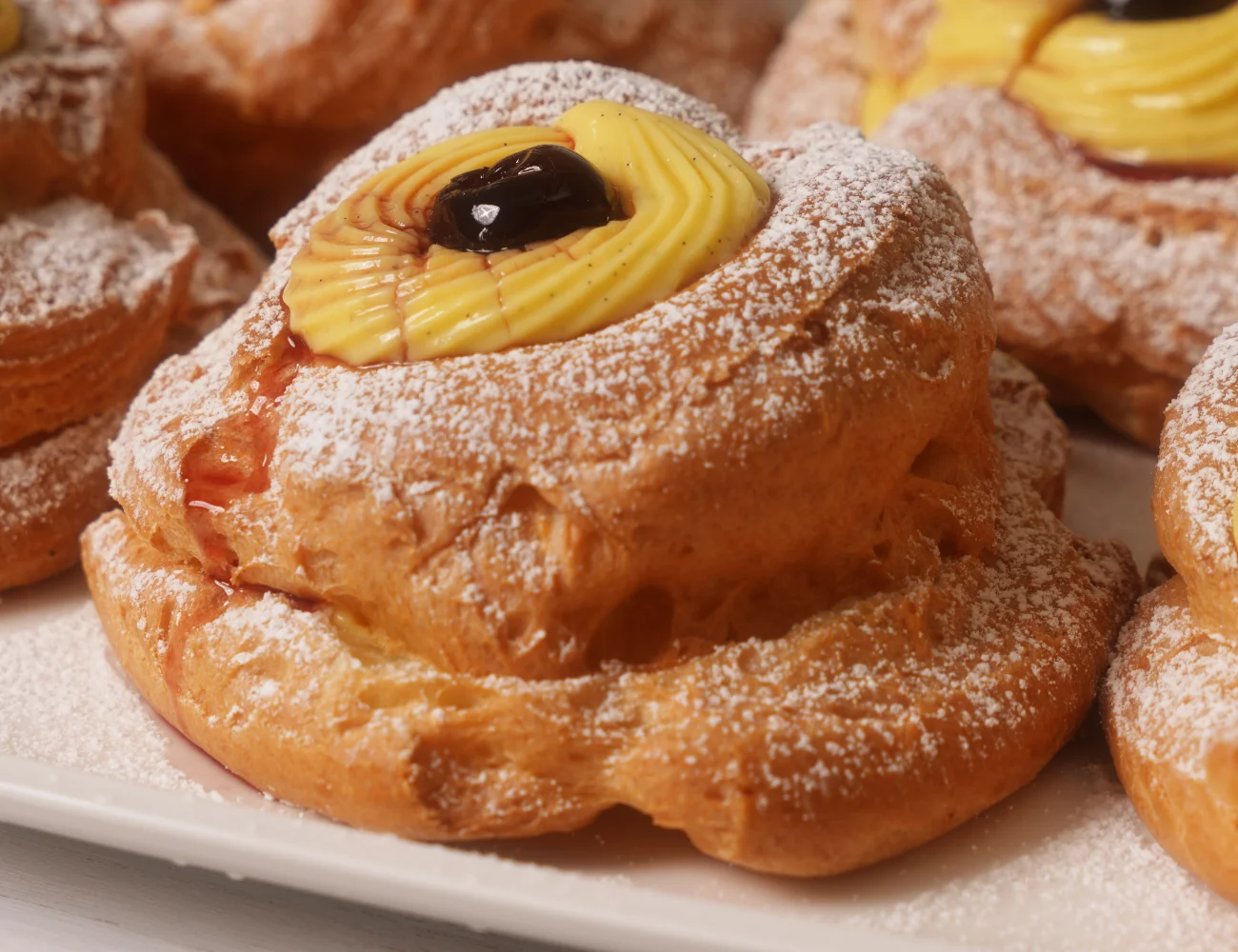
In Italy, the Zeppola di San Giuseppe belongs to March 19th — the Feast of Saint Joseph, which is also Father’s Day here. It is the dessert of that day, full stop. Bakeries queue out the door. Every pasticceria worth its salt has been piping and frying since before dawn. And the ones that are most loved — the ones that make you close your eyes — are the large, towering versions: golden, substantial, dusted with powdered sugar and crowned with a swirl of pastry cream and a single amarena cherry.
That amarena cherry is not optional. There is nothing quite like it — sour, syrupy, deeply flavored. It is the perfect finish to something rich and it is non-negotiable in this house.
Now — a word about what a Zeppola actually is, because this matters for making them correctly. At a glance it looks like a profiterole or an éclair. It is not. A profiterole is designed to be hollow — a thin, delicate shell piped full of cream. A Zeppola needs structure. It needs to stand on its own, support the weight of the cream on top, and have what I can only describe as a satisfying, “meaty” interior. Airy, yes — but not hollow. Getting that right is the whole game.
If you love Italian food cooked the right way, my cookbook “Pasta Affair: 50 Authentic Italian Recipes from Italy” was made for you.
The Choux Pastry (Pasta Choux)
The secret to a Zeppola that holds its shape — we’re talking 7 to 8 cm tall without flinching — is a well-made panade and the right flour-to-hydration ratio. Here’s what you need:
- Water: 250 g
- Butter: 100 g
- Flour: 180 g
- Whole Eggs: 4 large
- Sugar & Salt: 8 g each
Bring the butter and water to a rolling boil, then add the flour all at once. This is your panade — and you need to cook it properly. Keep stirring over the heat until the dough pulls away from the sides and a thin film forms on the base of the pan. That film tells you enough moisture has evaporated for the eggs to incorporate properly. Don’t rush this step. Once you’re there, take it off the heat and beat in the eggs one at a time until the dough is smooth, glossy and falls from the spoon in a slow, reluctant ribbon.
The Pastry Cream (Crema Pasticcera)
A Zeppola is only as good as its custard — and most recipes get this wrong. The cream needs to be firm enough to sit beautifully on top of the pastry without sliding off or weeping into it. I use a higher starch ratio than you’ll find in most standard recipes, plus a little butter at the end for that silky, rounded finish. This is the custard that holds.
- Whole milk: 500 g (replace 10% with heavy cream if you want it richer)
- Egg yolks: 120 g (approximately 6 large)
- Sugar: 120 g
- Vanilla: 1 bourbon vanilla bean, split and scraped
- Starch — choose one:
- Cornstarch (40 g): firm, classic hold
- Rice starch (40 g): silkier, glossier finish
- Flour (62.5 g): the traditional method — rustic, opaque, deeply satisfying
- Butter: 50 g, cold
- Sea salt: a pinch
Step 1 — Infuse and temper
Warm the milk with the vanilla bean and let it sit for 10 minutes off the heat — you want it to really drink in that vanilla. Meanwhile, in a heavy-bottomed saucepan, whisk together the yolks, sugar, and your chosen starch until the mixture is pale and the starch is fully dissolved. No lumps at this stage means no problems later.
Now temper: ladle the hot milk slowly into the egg mixture while whisking constantly. This raises the temperature of the eggs gradually so they don’t scramble when they hit the heat. Then return everything to the pan.
Step 2 — Cook it properly
This is where patience matters. Starch begins to thicken around 70–75°C, but you need to take the cream all the way to 90–95°C for the starch flavor to cook out completely and for the custard to reach its proper, stable consistency. Keep whisking. It will look thin, then suddenly it won’t — stay with it.
Step 3 — Finish and chill
Off the heat, whisk in the cold butter and the pinch of salt. The butter gives the cream its sheen and that smooth, rounded mouthfeel that separates a good custard from a great one. If you want absolute smoothness, pass it through a fine-mesh sieve. Then transfer immediately to a cold bowl, press plastic wrap directly onto the surface of the cream — contact coverage, no air — and refrigerate until fully chilled before using. Don’t skip the contact wrap; it’s what prevents the skin from forming.
Frying vs. Baking
In Naples, the traditionalists fry — and they’re not wrong. Deep-frying in peanut or sunflower oil produces a micro-blistered, crunchy exterior that contrasts beautifully with the soft, creamy interior. It is the version most Neapolitans grew up with and it is hard to argue against it.
That said, baking is a perfectly legitimate alternative and has its own character. Start at high heat to get the lift and structure, then drop the temperature for a drying phase that drives out residual moisture and gives you a pastry with real integrity. The result is more elegant, less rich — and the buttery notes of the dough come through more clearly.
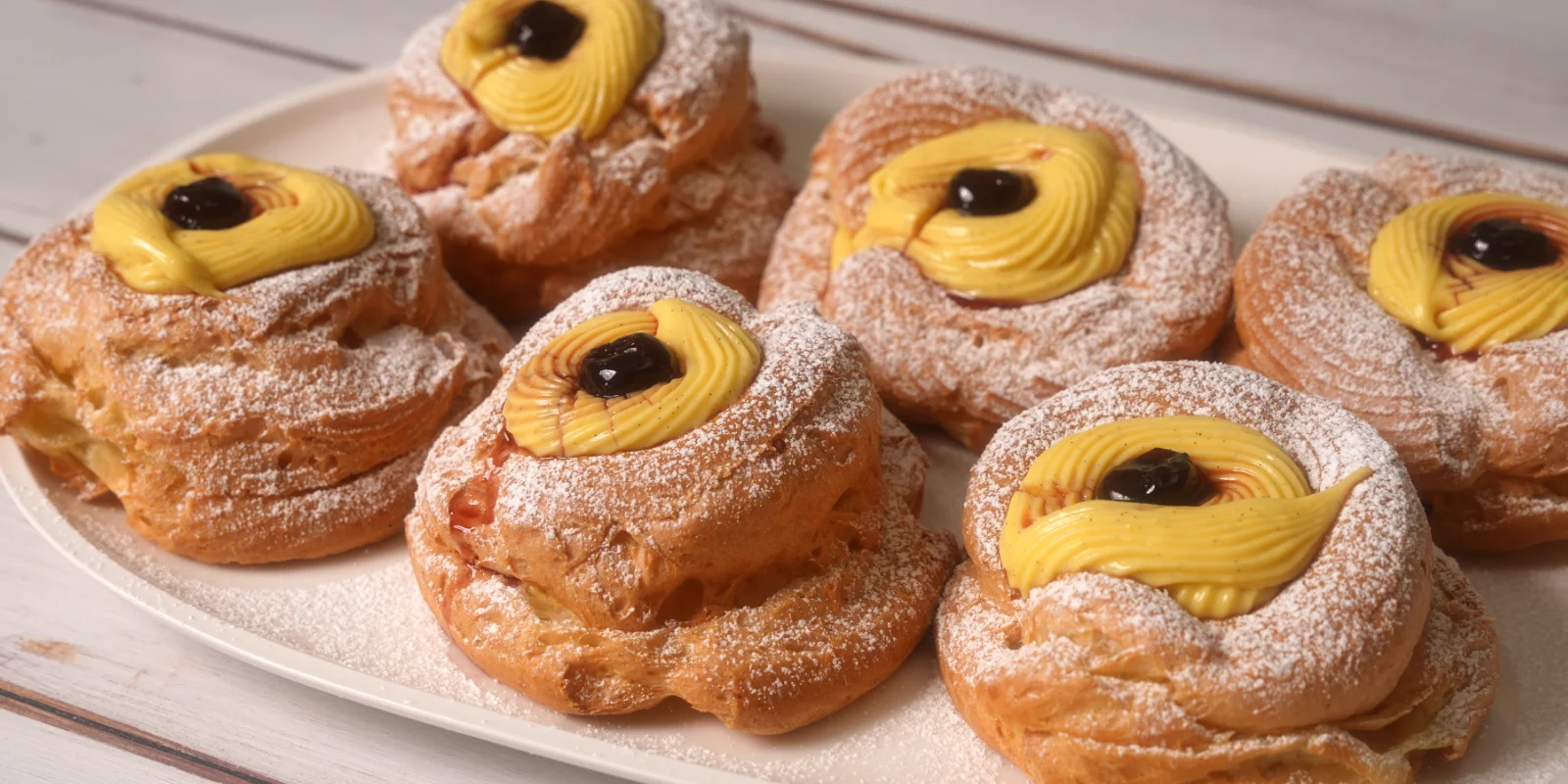
Both versions finish the same way: a generous swirl of chilled pastry cream in the center and one amarena cherry on top. That’s it. That’s the Zeppola.
Troubleshooting — What I Learned the Hard Way
After testing this recipe more times than I care to count, here are the problems I ran into and how to avoid them.
The Zeppola collapsed when I turned the oven off
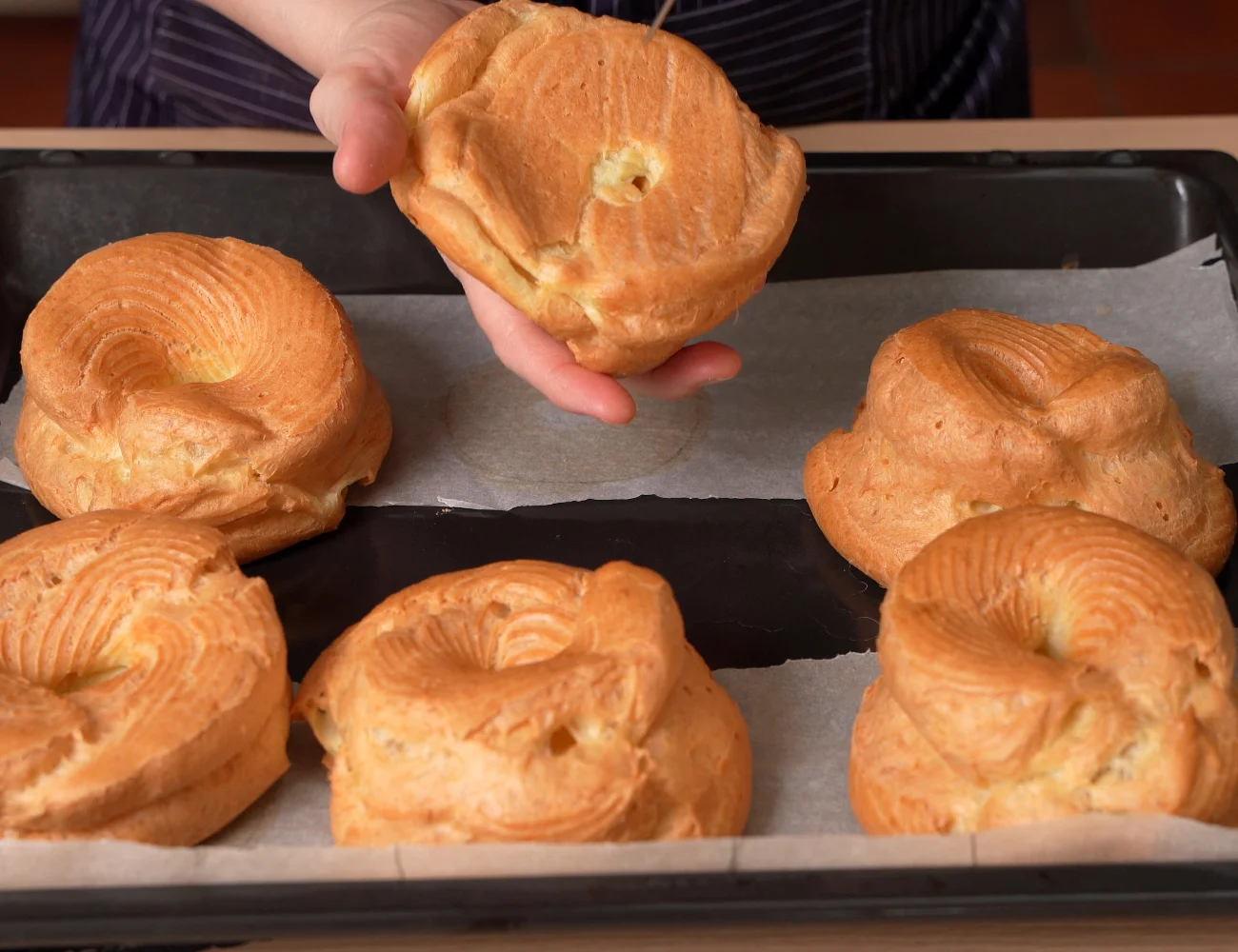
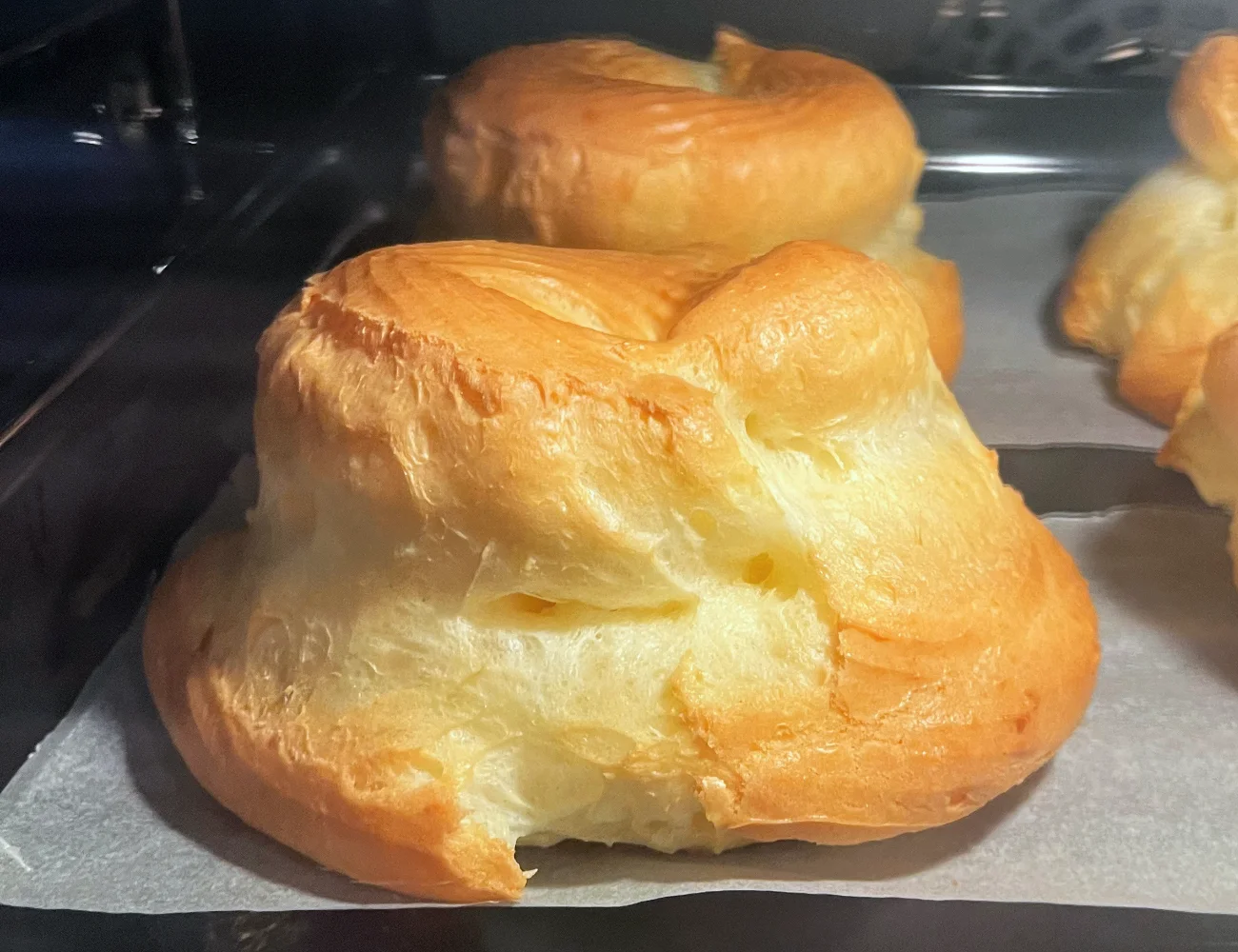
This is the most common and most heartbreaking failure — and it has one cause almost every time: pale seams in the pastry. When you pipe a Zeppola in two layers, the point where the two rings of dough meet is a structural weak point. If that seam hasn’t colored properly — if it’s still pale or undercooked while the rest of the pastry looks done — the structure is not set. The moment the heat drops, it collapses.
The rule is non-negotiable: the Zeppola must be uniformly golden brown everywhere — top, sides, and every seam. Not mostly golden. Not golden on top with a pale band in the middle. Everywhere. If you see any pale patches, leave it in the oven. A slightly darker Zeppola is far better than a collapsed one.
How to pipe two layers correctly
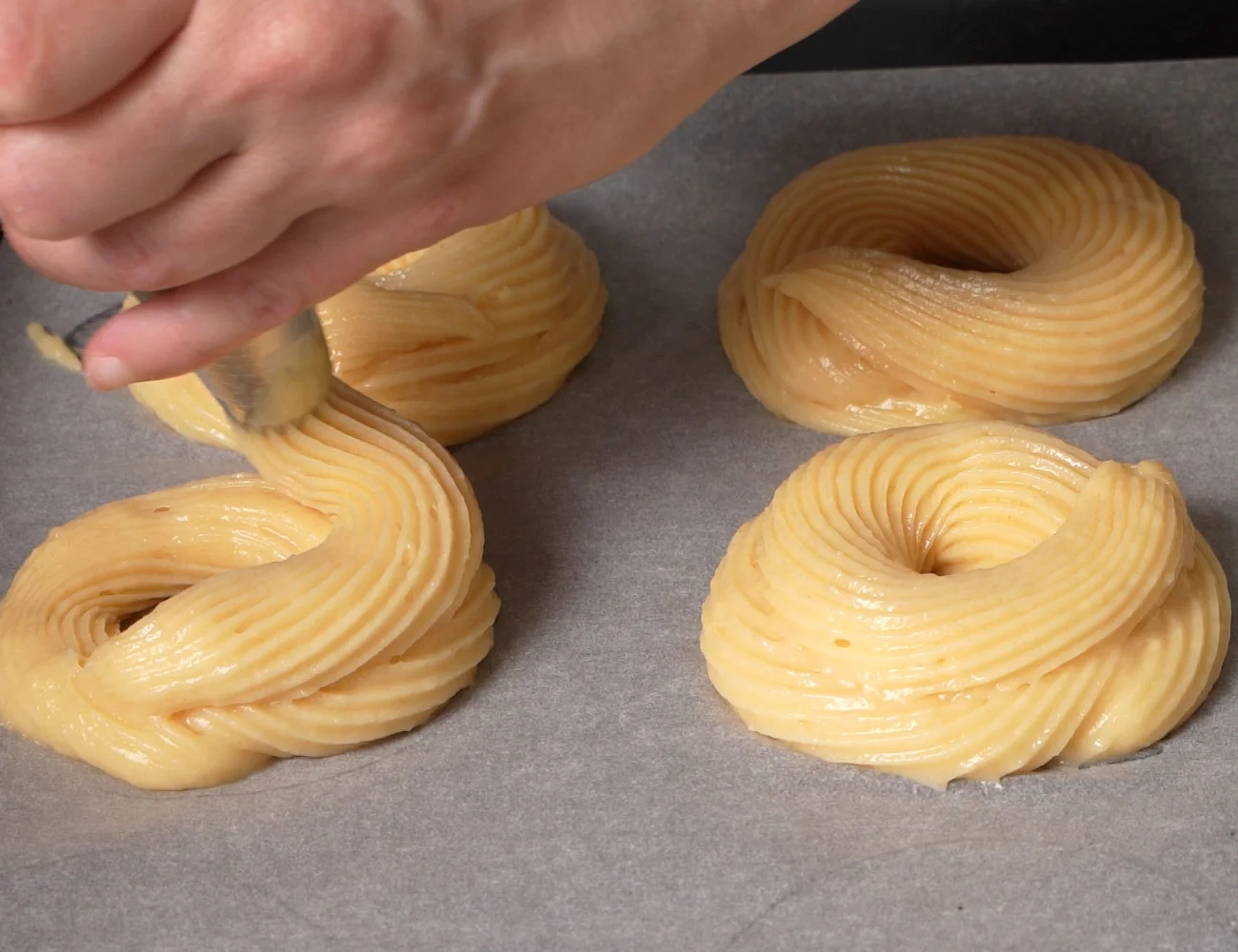
When building the double-ring structure of a large Zeppola, pipe the second layer of choux dough directly on top of the first — not beside it, not slightly overlapping it, but centered on top of it. This is what creates the tall, stable tower rather than a flat, wide ring that spreads sideways. Think of it as building upward, not outward. A star-tip nozzle gives you the ridged surface that helps the pastry color evenly across every surface, including those critical seams.
The cream is too runny and slides off
You either didn’t cook the custard to full temperature, or it wasn’t chilled enough before piping. The cream must be fully cold — not just cool — before it goes onto the pastry. If in doubt, give it another 30 minutes in the refrigerator. A properly made, fully chilled custard at this starch ratio will hold its piped shape without spreading.
The dough is too stiff to pipe smoothly
Your eggs were too cold, or you added them to a panade that was still too hot and they began to cook on contact. Always let the panade cool for a few minutes before adding the eggs — and use eggs at room temperature. The finished dough should be smooth, glossy, and fall from the spoon in a slow V-shaped ribbon. If it’s stiffer than that, beat in a little beaten egg, a small amount at a time, until you reach the right consistency.
As an Amazon Associate, we earn from qualifying purchases. This means at no extra cost to you, PIATTO may earn a small commission if you click the links and make a qualifying purchase.
Traditional Zeppole Recipe: Authentic Italian Pastry from the Heart of Italy
Equipment
- 1 medium sauce pan for making the pastry cream and the panade
- 1 large bowl or stand mixer bowl
- 1 hand or stand mixer to whip eggs into the choux pastry
Ingredients
The Choux Pastry (Panade)
- 250 g water
- 100 g butter
- 180 g flour
- 4 large eggs whole
- 8 g sugar
- 8 g salt
The Custard (Crema)
- 500 g whole milk
- 120 g egg yolks 120 g of yolks = 6 large
- 120 g sugar
- 1 vanilla bean seeds and pod
- 40 g cornstarch or same amount of rice starch
- 50 g butter
- 1 pinch salt
Instructions
The Choux Pastry (Panade Method)
- Hydration & Fat Melt: In a medium saucepan, combine the water, butter, sugar, and salt. Bring to a rolling boil over medium-high heat, ensuring the butter is completely melted before the liquid peaks.
- The Panade: Remove from heat and add the flour all at once. Stir vigorously with a wooden spoon until a cohesive paste forms. Return to medium heat and "dry" the dough for 2 minutes, stirring constantly, until a thin white film forms on the bottom of the pan.
- Cooling: Transfer the panade to a stand mixer bowl or a clean glass bowl. Let it sit for 5 minutes to drop below 60°C to prevent the eggs from scrambling upon contact.
- Egg Incorporation: Add the eggs one at a time, beating thoroughly after each addition. The dough is ready when it is glossy and falls from the spatula in a slow, heavy "V" shape (the "ribbon" stage).
- Piping: Transfer to a piping bag fitted with a large star nozzle. Pipe two concentric circles (stacking the second slightly inward) to create a 7-8 cm base with a high structural wall.
- Baking: Bake in a 190°C / 375°F oven ("fan") for 15 minutes.Then: Reduce the heat to 160°C / 320°F (without opening the oven door) and bake for another 20 minutes.
- Finish: Zeppole pastry is finished when there are no pale cracks and the entire shell is an even golden to light brown color.When baking is finished, turn off the heat. Let the Zeppole cool in the oven with the oven door ajar. Remove the shells and poke each with a small cake tester or similar to allow any internal steam to better escape.
- Cool the zeppole completely before assembly.
Instructions: The Pastry Cream (High-Stability Custard)
- Infusion: Combine the milk and vanilla (seeds and pod) in a pot. Bring to a simmer, then remove from heat and let infuse for 10 minutes.
- The Liaison: In a separate heavy-bottomed casserole, whisk the yolks and sugar until pale. Sift in your chosen starch (cornstarch or rice starch) and whisk until no lumps remain.
- Tempering: Remove the vanilla pod from the milk. Slowly pour a third of the hot milk into the egg mixture, whisking constantly to equalize the temperatures.
- Gelatinization: Pour the tempered eggs back into the remaining milk. Cook over medium-low heat, whisking non-stop. Once it begins to bubble, continue cooking for 1-2 minutes until it reaches peak viscosity (approx. 90-95°C).
- The Finish: Remove from heat and immediately whisk in the cold butter and a pinch of salt until the cream is glossy and emulsified.
- Thermal Shock: Transfer to a shallow tray or cold bowl. Cover with plastic wrap directly on the surface (touching the cream) to prevent a skin from forming. Chill in the refrigerator until completely cold before piping.
Assembling the Zeppole
- Whisk the chilled custard for 30 seconds to restore its creamy, pipeable fluidity.
- Using a sharp serrated knife, carefully slice each Zeppola in half horizontally. Aim for the midline to ensure both the base and the "crown" have equal structural integrity.
- Pipe a thin, even layer of custard (about 0.5 cm thick) onto the cut surface of the bottom half. Do not overfill here; the goal is to provide moisture and flavor without causing the top half to slide.
- Reconstruction: Place the top half back onto the custard-coated base. Press down very lightly to “anchor” the two pieces together.
- The Signature "Corona" (Crown): Using a large open-star nozzle, pipe a generous, concentric "nest" of custard on the very top of the Zeppola.
- Lightly dust the entire assembly with zucchero a velo (powdered sugar). Place one Amarena cherry in the center of the top custard nest, allowing a small drop of its dark syrup to settle into the vanilla cream.